

For seven consecutive years PHP has been the fourth most popular programming language worldwide, with PHP powering over 200 million websites , and 81,7 percent of public websites hosting PHP on their server.
PHP has taken a giant leap into the future this week with its first major update since 2004, when version 5.0 was released. PHP 7 dramatically improves performance , achieving three times the performance of PHP 5.6 when running on the WordPress CMS in some benchmarks. Below is an image illustrating this significant improvement.
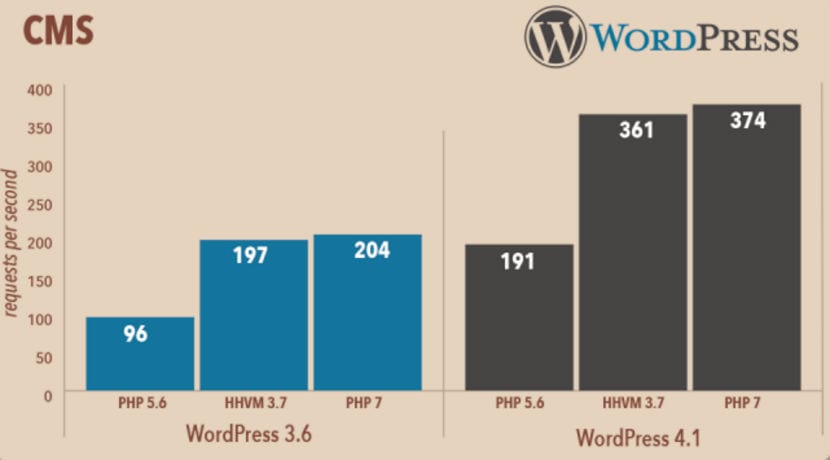
It also includes other minor changes, such as significantly reduced memory usage , return type declarations , special operators , and much more. PHP 7 contains a number of last-minute changes, including the removal of PHP's safe mode , "magic quotes ," several new reserved keywords, and other modifications.
This means that web applications (CMS) like WordPress needed to be partially redesigned in order to be ready for a future release with PHP 7, although it now appears to be fully compatible with the upgrade.
While PHP 7 is already available , it will likely be a few years before it sees widespread adoption on the web. Web applications, especially enterprise ones, tend to take years to update to new versions as soon as a new update is released.
What many web developers are hoping for is that the performance improvements will be considerable, and that this will encourage them to update much sooner, both WordPress itself and the themes they use.